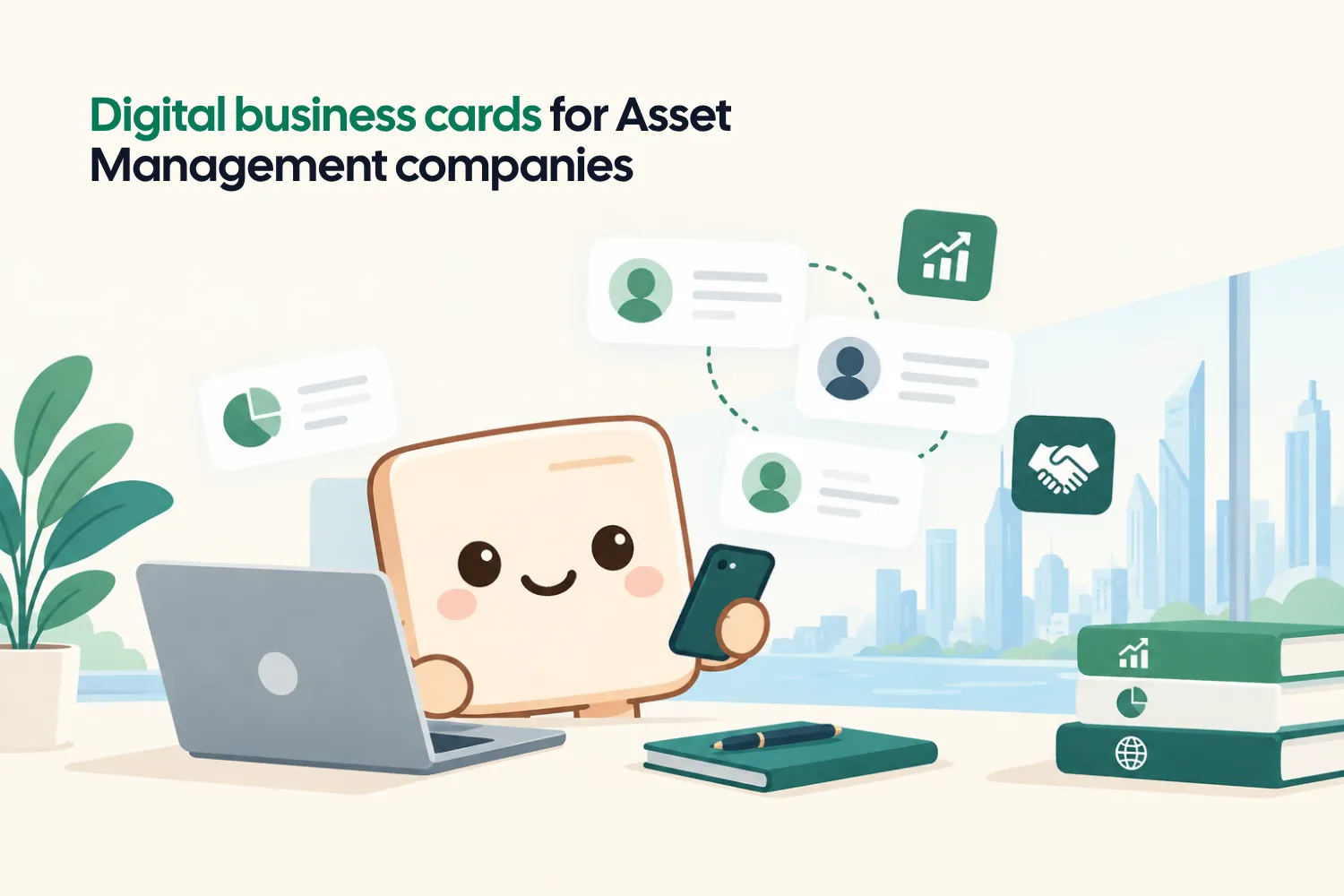
In Asset Management, a significant part of the business revolves around relationships.
A meeting with an investor. An industry conference. A results presentation. A meeting with a potential client. A conversation at an event that starts informally and ends up becoming a business opportunity.
In all these situations, one thing remains the same: exchanging contact details.
And while traditional business cards still have their place, it is becoming increasingly difficult to justify why all that information should depend on a small piece of paper.
A business card can be lost, become outdated, or end up at the bottom of a drawer. A digital business card, on the other hand, can be updated, shared from a smartphone, and connected to the tools a team already uses.
For an Asset Management company, the difference is not simply about replacing paper. It is about turning every exchange of contact details into a connection that can continue to be managed afterwards.
What exactly is an Asset Management company?
Before discussing digital business cards, it is worth clarifying one thing.
Asset Management is a broad concept. It does not refer exclusively to financial advisors. Companies in this sector manage assets and portfolios for different types of clients, from individual investors to institutions, funds, and high-net-worth individuals.
Within an organisation, there can be many different roles: investment managers, portfolio managers, relationship managers, financial advisors, analysts, business development professionals, and sales teams.
Although their responsibilities may differ, many of them share the same need: building and maintaining professional relationships.
The industry is also changing. According to PwC’s Global Asset & Wealth Management Report 2025, 69% of institutional investors surveyed say they are likely to allocate capital to asset managers that develop technological capabilities to provide enhanced products and services.
Technology is therefore no longer limited to investment management. It is also transforming how companies in the sector interact with clients and manage their business activities.
Why use digital business cards in Asset Management?
Imagine a fairly common situation.
A relationship manager attends an industry event and meets ten people over the course of a morning, including investors, partners, and potential clients. Several business cards are exchanged, and the relationship manager returns to the office with pockets full of paper.
The real work starts afterwards.
Contacts need to be saved, people need to be identified, notes need to be added, information needs to be entered into the CRM, and follow-ups need to be planned.
A digital business card can simplify much of this process.
Share contact details instantly
A digital business card can be shared via QR code, link, or NFC. The recipient can open it directly on their smartphone and save the information without having to enter the details manually.
With Knowee, cards can also be shared via NFC, QR code, or a direct link.
This is particularly useful at conferences, meetings, and events where every conversation matters and there is not always time to exchange information carefully.
Keep information up to date
This may seem like a minor issue until you are managing a large team.
A professional changes roles. Their phone number changes. They move to a different office. The company updates its visual identity.
With a printed business card, each change may mean having to print a new batch of cards.
With a digital business card, information can be updated directly from the platform while the card’s link remains the same.
With Knowee, companies can manage their employees’ cards from a centralised platform and make individual or bulk changes.
It is like having a business card that does not become outdated every time a detail changes.
A consistent corporate identity across the entire team
In Asset Management, professional image matters.
There is a significant difference between having every employee use a different business card and having the entire team share a consistent visual identity.
An asset manager can create templates with its logo, colours, fonts, and information structure, while allowing each professional to maintain their own personal details.
This means that a portfolio manager, a relationship manager, and a business development professional can each have different cards while still being clearly recognisable as part of the same organisation.
Knowee allows companies to centralise this management and maintain control over the corporate identity of their team’s cards.
At this point, the business card becomes more than a personal networking tool. It becomes part of the company’s brand management strategy.
From exchanging business cards to managing contacts
This is probably the most important part.
A business card should not be the end of a conversation.
It should be the beginning.
In a traditional process, it might look something like this:
Meeting → physical business card → save the card → enter the details → CRM → follow-up
Every additional step creates another opportunity for something to get lost along the way.
With a digital solution, the process can be much more direct:
Meeting → digital exchange → contact → contact manager → CRM → follow-up
This becomes even more relevant for sales teams that generate new contacts on a regular basis.
Knowee includes a contact manager where professionals can store both digital business cards and scanned physical business cards. Contacts can also be exported and integrated with CRM tools.
Knowee also integrates with platforms such as Salesforce and HubSpot, allowing contact information to become part of the company’s existing sales workflow.
If you would like to explore this topic further, read our article on how to synchronise business cards with Salesforce and avoid losing leads.
Which Asset Management professionals can use a digital business card?
There is no single profile for which digital business cards make sense.
Relationship managers
They are probably among the professionals who rely most heavily on networking in their day-to-day work. A digital business card makes it easier to exchange information during meetings and events while keeping professional details up to date.
Investment managers and portfolio managers
Even when their role is not directly sales-focused, they still need to interact with investors, institutions, partners, and other professionals across the industry.
Financial advisors
For professionals who maintain direct relationships with clients and prospects, having a simple way to share professional information can make the initial connection easier.
Business development teams
Here, networking is directly connected to commercial activity. Trade shows, conferences, meetings, and presentations can generate dozens of new contacts.
Executive teams
Managing Directors, Investment Directors, CEOs, and other senior professionals can also benefit from a digital business card that accurately represents the company’s identity and makes it easier to exchange professional information.
What about physical business cards?
There is no need to choose between physical and digital.
For some professionals, handing over a physical business card during a meeting remains a natural part of the conversation.
This is where NFC comes in.
A physical NFC business card can be linked to the professional’s digital business card. When it is tapped with a compatible smartphone, the digital profile opens with the professional’s information.
It can also include a QR code as an alternative.
This turns the physical business card into a gateway to the digital profile rather than simply a static piece of printed information.
With Knowee, NFC cards can be updated without replacing the physical card because they are linked to the digital profile.
Technology and human relationships can go hand in hand
There is an interesting paradox here.
The more digital the financial sector becomes, the more important human relationships remain.
PwC reports that 50% of asset managers surveyed are looking for greater convergence with wealth management and fintech to build technology ecosystems capable of serving increasingly diverse client segments.
A digital business card does not replace a conversation, a meeting, or a trusted relationship.
It simply removes some of the friction that comes afterwards.
Less paper, more control
There is also a sustainability aspect to consider.
A company with dozens or hundreds of professionals may need to replace business cards whenever job titles, phone numbers, departments, or branding elements change.
Digitising part of this process reduces reliance on printing and allows information to be managed from a single place.
For companies that already have sustainability objectives or ESG policies in place, this can be a small but meaningful change within a much broader digitalisation strategy.
The idea is not that a digital business card will solve an organisation’s environmental challenges on its own.
It is about gradually eliminating physical processes that are no longer necessary.
Discover your yearly savings in costs and resources by switching to digital cards.
A business card that is part of something bigger
For an Asset Management company, digitising business cards may seem like a small change.
But when you look at the entire process, the opportunity is much greater.
Corporate branding.
Networking.
Contact management.
CRM.
Analytics.
NFC.
Sustainability.
It all starts with something as simple as sharing contact details.
But the ultimate goal is to make sure that connection is not lost after the meeting.
With Knowee, companies can centralise their teams’ digital business cards, maintain a consistent corporate identity, manage contacts generated through meetings and events, and connect networking activity with their existing sales tools.
Because a business card may last only a few seconds. A good professional relationship can last much longer.