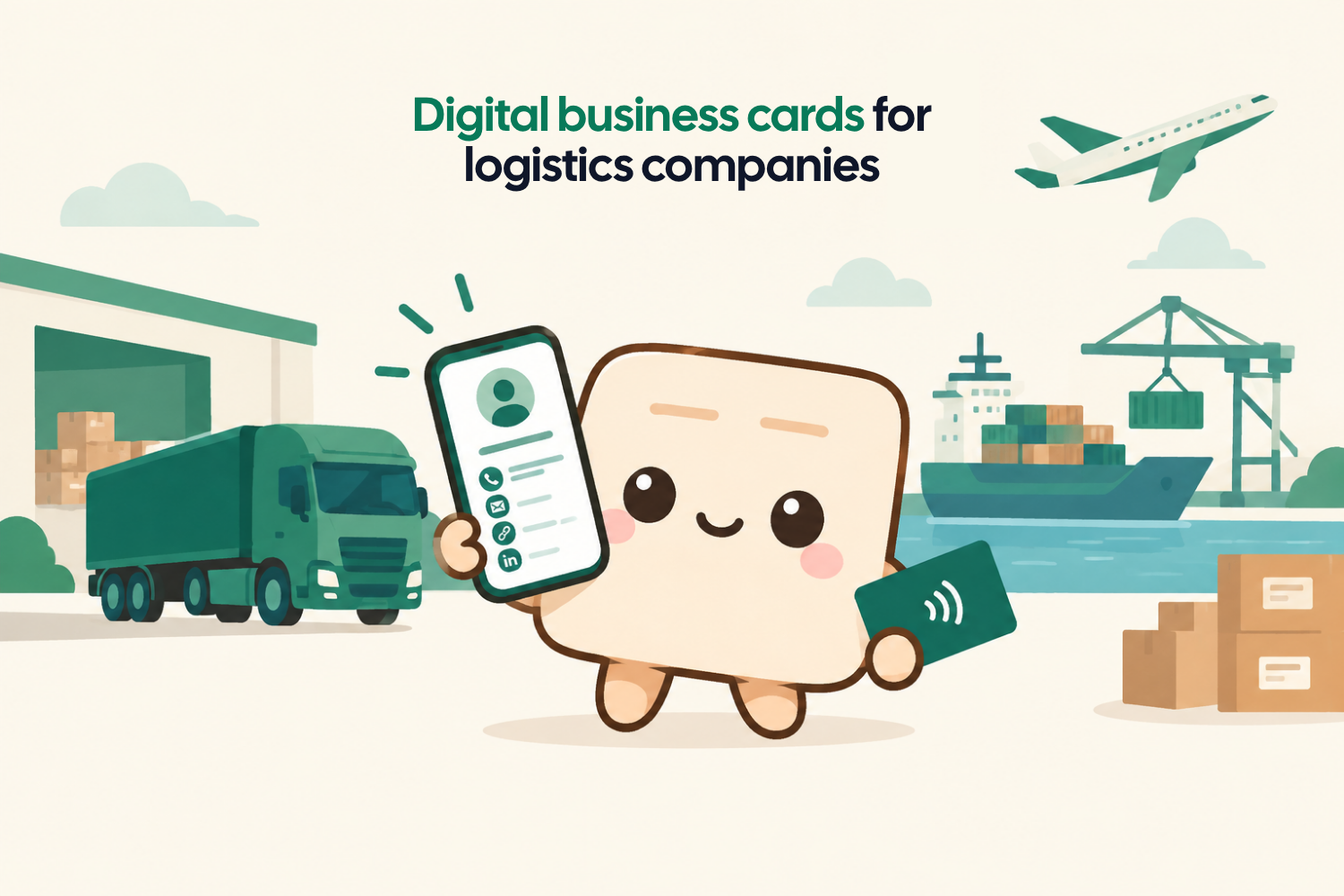
In logistics, a strong business relationship can start anywhere.
At an international trade show. During a customer visit. In a meeting with a supplier. At a warehouse, a port, or even after a call when someone says: “I’ll send you my details.”
And that is where a small problem appears, one that many people know well.
A paper business card can end up in a jacket pocket, inside a notebook, or lost among dozens of cards after an event. And when someone needs to contact you weeks later, they may not even remember where they kept your details.
For a logistics company, where relationships, suppliers and international customers are part of everyday business, every contact matters.
That is why digital business cards can become a much more useful tool than simply an alternative to traditional paper business cards.
Logistics is a business built on connections
The logistics industry includes many different types of companies, but many of them have one thing in common: they constantly need to connect with other businesses and professionals.
There are transport and freight companies, which move goods by road, rail, sea or air.
There are freight forwarding companies, which coordinate international shipments and work with multiple carriers, agents and customers.
There are also 3PL and 4PL providers, which manage part or even a large part of their customers’ supply chains.
And there are warehousing, distribution and last-mile companies, which are becoming increasingly important for e-commerce and omnichannel distribution.
In all these businesses, sales teams, account managers, procurement, operations, management and marketing teams exchange contact details constantly.
In fact, the importance of logistics goes far beyond moving goods. According to DHL eCommerce’s 2025 report, 96% of retailers consider their logistics offering important for generating sales.
When logistics directly influences the customer experience, the way logistics companies present themselves, communicate and maintain business relationships also matters.
A digital business card is more than just a business card
The difference lies in what happens after the card is shared.
With a traditional business card, you provide a name, phone number, email address and little more.
With a Knowee digital business card, the contact can access an up-to-date professional profile from their mobile phone, including professional information, links, social media profiles and other company content.
It can also be shared through QR code, direct link or NFC, including with a physical NFC business card that acts as an entry point to the digital business card.
And this offers a particularly useful advantage for logistics companies: information can be updated without changing the physical card or printing hundreds of new cards.
If a sales representative changes their phone number, job title or department, the digital information can simply be updated.
The card that has already been shared continues to work.
How sales teams can use digital business cards
Imagine a sales representative from an international transport company at a logistics trade show.
Over two days, they speak with dozens of potential customers and partners. Some people carry paper business cards. Others exchange contacts through LinkedIn. Others simply write down a phone number.
With Knowee, the process can be much simpler.
The sales representative can display their QR code, share a link from their phone or use an NFC business card. The contact can access their details directly and save them.
But there is something even more interesting.
The team can use the Knowee Cardholder to save the business cards they receive, scan paper business cards using OCR and organize contacts collected during meetings and events.
This means a trade show does not end when the booth is taken down.
The contacts remain within the company’s sales ecosystem.
And if the company uses Salesforce, these contacts can become part of the sales workflow. Knowee allows teams to scan physical business cards, turn their information into contacts and sync them with Salesforce, reducing manual work for the sales team.
Discover how to digitize business cards with Knowee and sync them with Salesforce →
Every type of logistics company can use digital business cards differently
Transport and freight companies
Freight forwarders work with a particularly large network of customers, agents and business partners.
Here, the value lies in maintaining a consistent professional identity and making it easier to exchange contacts, especially in international environments.
In addition, when different team members represent the same company, everyone can use digital business cards with the same visual identity and structure.
Freight forwarders
Freight forwarders work with a particularly large network of customers, agents and business partners.
Here, the value lies in maintaining a consistent professional identity and making it easier to exchange contacts, especially in international environments.
In addition, when different team members represent the same company, everyone can use digital business cards with the same visual identity and structure.
3PL and 4PL companies
These companies may have sales teams, operations teams, customer success teams and specialists responsible for different accounts.
A corporate digital business card platform allows the company to manage the entire team’s cards from one place, keeping contact information and brand identity up to date.
This is especially useful when many employees regularly share their contact information.
Warehousing and distribution
For companies with teams spread across offices, warehouses and logistics centers, a digital business card reduces the need for printed cards that have to be produced and distributed continuously.
Employees can also keep their business card on their phone and share it even when they are away from the office.
Last-mile and e-commerce
In last-mile logistics, relationships with customers and partners can be particularly dynamic.
A digital business card can be used by sales teams, account managers and executives to maintain a professional and always-up-to-date point of contact.
And when a company operates across different markets, having a consistent digital identity helps ensure that every contact receives the same corporate information.
Marketing teams can benefit too
This is where a digital business card becomes more than just a sales tool.
Marketing teams can use it as an extension of the company brand.
For example, everyone attending a trade show can share digital business cards with the same design, logo, colors and structure.
Additional content and links can also be included to help continue the conversation after the event.
Analytics can show what happens after a business card is shared: visits, saves, interactions and other activity within the card.
This can provide useful insights after a trade show.
Because knowing how many business cards were handed out is one thing.
Knowing how many people actually interacted with them is something very different.
Spend less time looking for contacts and more time selling
This is particularly relevant for sales teams.
According to Salesforce, in 2026 the average salesperson spends approximately 40% of their time selling, while the rest is spent on other activities.
Every small process that reduces administrative work can help sales teams spend more time on what they actually need to do: speaking with customers, preparing proposals, negotiating and closing deals.
Digitizing contact sharing will not solve every challenge a sales team faces.
But it can remove a common source of friction: receiving a contact and then having to enter the information manually into different tools.
A tool that also fits an international business strategy
Logistics rarely operates within a single market.
The same team may work with customers in Spain, Germany, the United Kingdom, the United States or Latin America during the same week.
This makes the first impression even more important.
A digital business card allows professionals to share the same business information from anywhere, regardless of where the meeting takes place.
There is also no need for the person receiving the card to have the Knowee app installed. The digital business card opens directly in their web browser.
It is a small detail, but an important one.
The fewer barriers between “I’ll send you my details” and “Here is my contact information,” the better.
The connection does not end when the card is shared
This is probably one of the biggest differences compared with a traditional business card.
A paper business card finishes its job when it is handed over.
A digital business card can continue working afterwards.
It can link to the company website, LinkedIn, a contact form or other content. It can be updated. It can be measured. And in a corporate environment, it can be managed together with the rest of the team’s business cards.
In addition, Knowee allows companies to connect digital business card management with CRM tools such as Salesforce and HubSpot, making contact sharing part of a broader sales process.
Discover how Knowee digital business cards work for companies →
Logistics is becoming more digital. The way companies connect is too
Digital transformation in the logistics industry is not limited to automated warehouses, management systems or shipment tracking.
It also affects the small tasks that are part of everyday business.
DHL, for example, has highlighted the importance of digitalization in improving customer experience and operational efficiency in recent years and has made significant investments in digital transformation.
And the industry continues to evolve. The DHL Logistics Trend Radar 8.0, published in September 2026, highlights how AI, robotics and automation are transforming logistics operations, while also emphasizing that logistics will continue to be a people-centered business.
That is precisely why digitizing the way companies connect with those people also makes sense.
Because behind every shipment, there is a customer.
Behind every customer, there is a relationship.
And many times, that relationship starts with something as simple as exchanging a business card.
Want to digitize your team’s business cards?
Email us at: support@know.ee or schedule a demo and we will show you the platform in action.