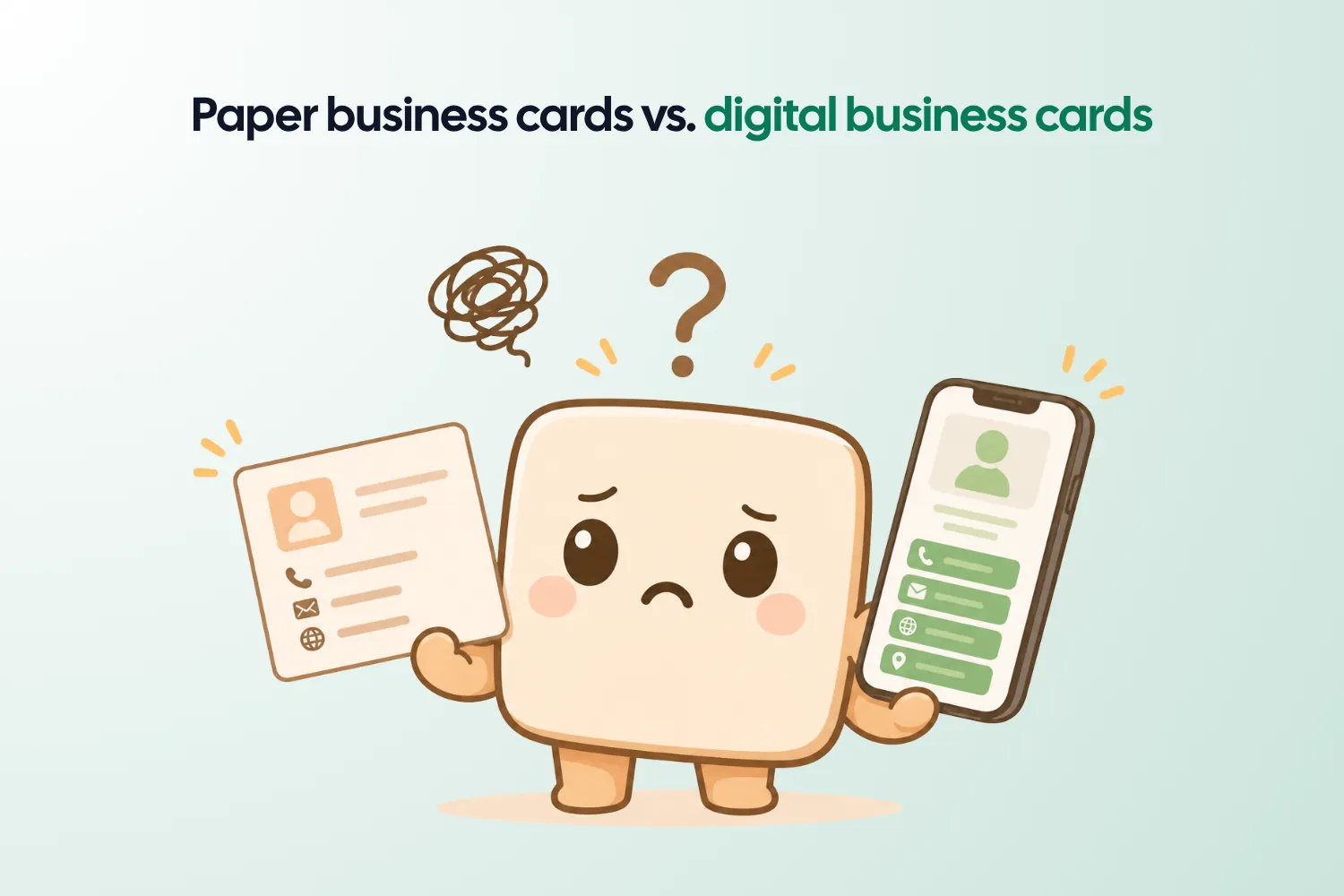
Paper business cards or digital business cards? For years, the answer seemed obvious. Companies printed thousands of cards for their employees and used them in meetings, trade shows, conferences, and networking events.
But the way we work has changed.
Contact information is no longer static. Employees change roles, phone numbers, or departments. Companies update their visual identity and need to maintain a consistent brand image across all their touchpoints.
This is where digital business cards for companies offer an interesting alternative to paper.
It is not simply about replacing a physical card with a link. It is about being able to update information instantly, track how a card is shared, store contacts received, and reduce the costs associated with printing.
So, what are the main differences between paper and digital business cards?
Paper vs. digital business cards: key differences
The most obvious difference is the format, but for a company, there is much more to consider.
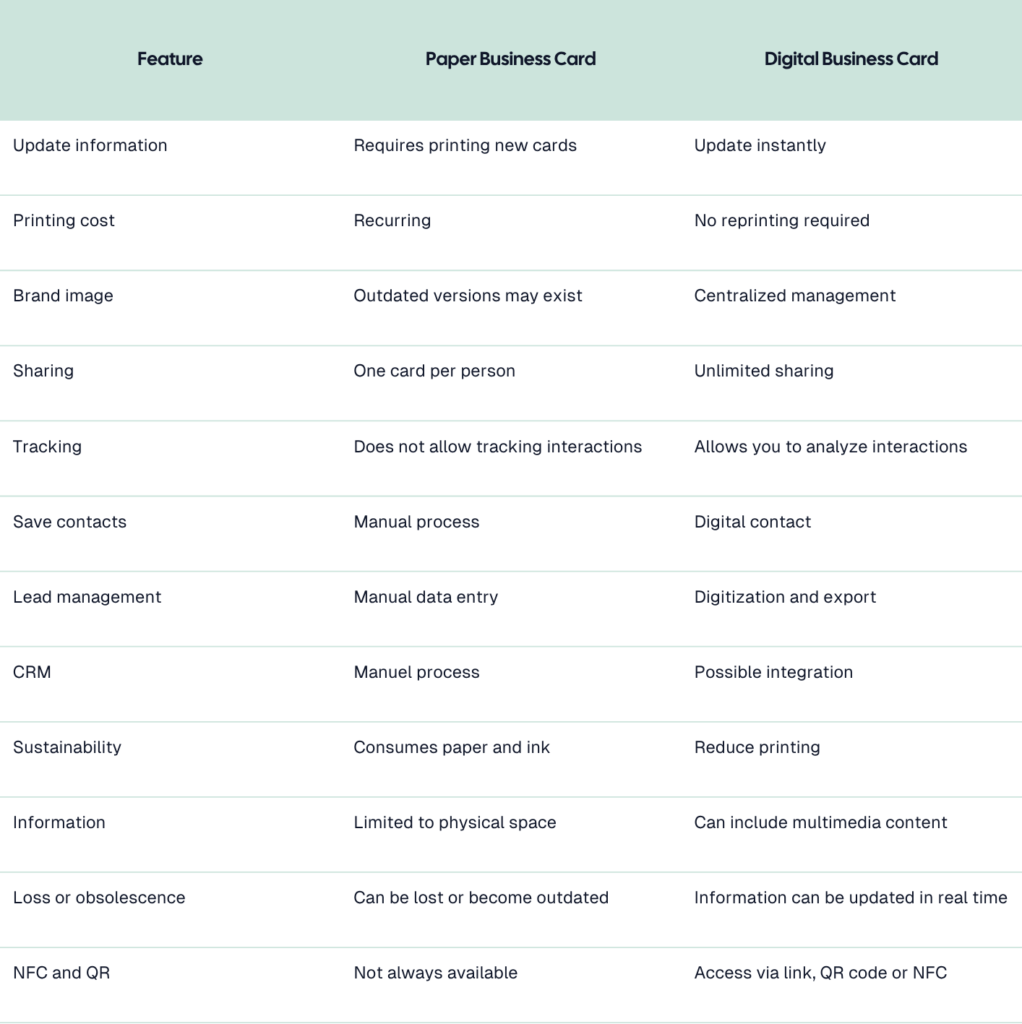
That is why, for many companies, the question is no longer simply paper vs. digital, but how to use both formats together in a complementary way.
Why are companies switching from paper to digital business cards?
A paper business card has one fundamental limitation: once it has been printed, the information cannot be changed.
If an employee changes their job title, gets a new phone number, or the company updates its website, the cards that have already been printed will still show the old information.
And this can become a challenge when managing large teams.
Printing cards for 10 employees is simple. Doing it for 100, 500, or 1,000 people means managing orders, designs, inventory, and new print runs every time information changes.
With a digital business card, information can be updated without having to print new cards.
The employee can continue sharing the same card, while the person receiving it will always find the latest information.
Fewer print runs, lower costs
The savings are not limited to the price of each card.
Companies also need to consider the time spent preparing designs, placing orders, storing cards, and managing new print runs.
There is another cost that often goes unnoticed: cards that eventually become unusable.
An employee leaves the company.
Someone changes their position.
A phone number changes.
The company updates its branding.
All previous cards are no longer an accurate representation of the company.
With a digital solution, these changes can be managed from a centralized platform.
A digital business card can always stay up to date
One of the main advantages of digital business cards for companies is the ability to update information at any time.
This is especially useful for Human Resources, Marketing, and Sales teams.
Companies can manage elements such as:
· First and last name
· Job title
· Phone number
· Email address
· Website
· Social media profiles
· Address
· Corporate image
· Logo
· Colors and visual elements
· Multimedia content
This allows employees’ cards to follow the same brand guidelines.
It also prevents each employee from ending up with a different version of the company’s business card.
With Knowee for companies, organizations can manage their digital business cards and maintain consistent corporate branding from a centralized platform.
Digital business cards make networking measurable
This is where we see a major difference that can completely change how a business card is used.
When an employee hands out a paper business card, the company usually has no way of knowing what happens next.
Did the person save the contact?
Did they visit the website?
Did they check the card again?
Was contact information exchanged?
With a digital business card, it is possible to collect information about these interactions.
Depending on the platform, a company can analyze metrics such as:
· Number of card views
· Number of times a card has been shared
· Contacts saved
· Contact exchanges
· Activity from different employees
·Card performance at events and in campaigns
In fact, a study published by Adobe in 2016 found that 88% of business cards handed out are thrown away within a week.
This makes a digital business card more than just a tool for sharing contact information. It can also become a source of valuable data.
With Knowee Analytics, for example, companies can track different metrics to understand how their digital business cards are performing.
From paper to CRM: digitizing received business cards
There is another common challenge at trade shows and events.
The sales team returns to the office with dozens of paper business cards, and that is when the manual work begins.
Name. Company. Email. Phone number. Job title.
All this information has to be entered into a database or CRM.
Digital business cards can help reduce this manual work.
Employees can use the app to scan paper business cards and turn the information into digital contacts.
These contacts can be stored in a corporate contact manager and later exported or integrated with the CRM.
This means that paper business cards collected at a trade show do not have to end up in a drawer.
They can be turned into useful data to help continue and develop a business relationship.
Discover how to digitize contacts and integrate them with Salesforce.
Are digital business cards more sustainable?
Sustainability is another reason why many companies are reducing their use of paper.
Every printed business card requires paper, ink, energy, and transportation. In addition, when information changes, new cards need to be produced.
Reducing printing can help lower resource consumption and the amount of waste generated.
The U.S. Environmental Protection Agency (EPA) highlights how paper recovery and recycling can help reduce resource consumption and emissions associated with paper production and waste management.
In addition, an academic study based on a life cycle assessment compared paper business cards with a digital alternative and concluded that, in large-scale usage scenarios, digital business cards could offer advantages from an energy and environmental perspective.
Of course, this does not mean that every digital solution automatically has a lower environmental impact. The result depends on the usage scenario and the life cycle of each alternative.
However, for a company that prints and replaces thousands of business cards every year, reducing printing can be a simple way to lower resource consumption.
What if a company wants to keep using physical business cards?
There is no need to choose exclusively between paper and digital.
In fact, combining both formats can be an especially interesting option for companies that regularly take part in trade shows, conferences, and networking events.
A physical business card with NFC and a QR code can act as a gateway to a digital business card.
Instead of simply displaying a name, phone number, and email address, the card can provide direct access to a digital profile through an NFC-compatible smartphone or by scanning a QR code.
Knowee’s BioPVC NFC business cards combine the physical format with NFC technology and a QR code.
This allows a company to maintain the visual impact of a physical business card while also offering a digital experience.
How much can a company save with digital business cards?
This is probably one of the most important questions.
The answer depends on the size of the company and the number of business cards it prints.
A company with 20 employees will have different needs from an organization with 500 employees.
That is why, instead of using a generic figure, it is more useful to calculate the potential impact using each company’s actual data.
Knowee’s Eco Calculator allows companies to estimate how much they could save by using digital business cards, as well as the resources they could save and the potential reduction in CO₂ emissions.
It is a simple way to answer a question that many companies should be asking:
How much does it really cost us to keep printing business cards?
Paper vs. digital business cards: which should a company choose?
There is no one-size-fits-all answer.
Paper business cards are still useful in certain situations. They are physical, simple, and familiar.
However, they have one clear limitation: once they are printed, they cannot be updated.
Digital business cards solve precisely this problem.
They allow companies to keep information up to date, control their brand image, share information without limits, and gain insights into the interactions generated through their cards.
They can also connect with contact management tools and CRMs, making it easier to ensure that contacts collected during meetings, trade shows, and events are not lost.
And for companies that still want to hand out something physical, an NFC business card with a QR code can offer the best of both worlds.
In the end, the question is not simply whether to choose a paper or digital business card.
It is about asking what a company needs to manage its contacts more effectively, reduce costs, and maintain a consistent brand image.
In this context, digital business cards have one advantage that is difficult to ignore: they never become outdated when information changes.